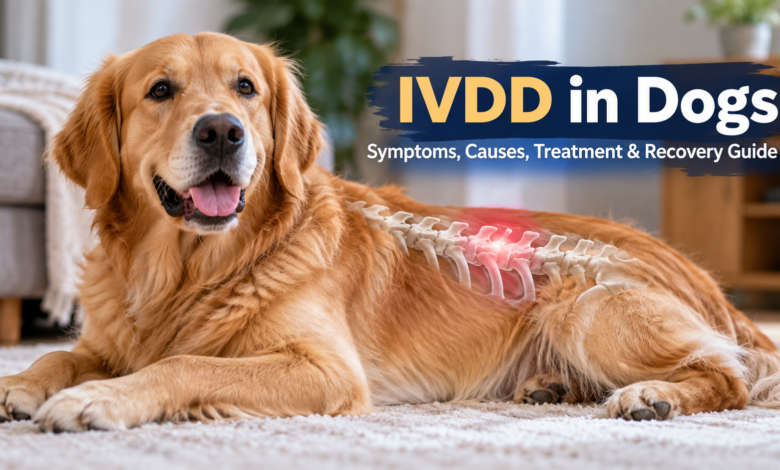
Intervertebral disc disease can quickly change a dog’s mobility. IVDD occurs when one of the cushioning discs between the vertebrae degenerates, bulges, or ruptures, putting pressure on the spinal cord or nearby nerves. Depending on the location and severity, a dog may develop back or neck pain, weakness, an unsteady walk, or even paralysis.
Recognizing the signs early matters because neurological damage can become serious. In this guide, you’ll learn what IVDD means, the common symptoms and causes, how veterinarians diagnose it, available treatment options, recovery expectations, and when a dog needs emergency veterinary attention.
What Is IVDD in Dogs?
IVDD stands for intervertebral disc disease. A dog’s spine contains individual vertebrae separated by flexible discs that act as shock absorbers. Each disc has a tougher outer layer surrounding a softer inner center. With degeneration, the disc can lose its normal structure and either protrude or rupture.
When disc material presses against the spinal cord or spinal nerves, neurological problems can develop. Some dogs experience only pain, while others develop weakness, poor coordination, loss of bladder control, or paralysis.
Disc disease can present in different patterns. Acute disc extrusion often causes sudden neurological signs, while chronic disc protrusion may develop more gradually. The location also matters. A disc problem in the neck can cause neck pain and problems affecting multiple limbs, while disease in the middle or lower back commonly affects the hind legs.
IVDD Symptoms to Watch For
The symptoms of IVDD can range from subtle discomfort to severe paralysis. A dog does not always cry or show obvious pain, so that behavioral changes can be important clues.
Common signs include:
- Reluctance to walk, run, jump, or climb stairs
- Stiffness or an unusual posture
- Neck or back pain
- Shivering, trembling, panting, or restlessness
- A hunched back or lowered head
- Wobbly or uncoordinated walking
- Dragging or knuckling the paws
- Weakness in one or more legs
- Difficulty standing or rising
- Loss of bladder or bowel control
- Partial or complete paralysis
Treat a dog that suddenly cannot walk as an emergency. Severe weakness, rapidly worsening neurological signs, or paralysis can indicate significant spinal cord compression.
Because dogs may hide pain, even a quieter change—such as refusing to jump onto furniture or avoiding stairs—deserves attention when it appears suddenly.
Causes and Risk Factors for IVDD
Disc degeneration is the central problem behind IVDD, but some dogs are more susceptible than others. Genetics, body structure, age, and the type of disc degeneration can all influence risk.
Dachshunds are particularly well known for disc disease because their long backs and short legs are associated with accelerated disc degeneration. Other predisposed breeds can include Beagles, Poodles, Pekingese, French Bulldogs, Cocker Spaniels, and several other breeds.
However, IVDD is not limited to small or long-backed dogs. Larger dogs can also develop degenerative disc problems, particularly as they age.
A sudden jump or minor accident may trigger symptoms, but the underlying disc may already be weakened by degeneration. Excess body weight can also increase mechanical stress on the spine.
Importantly, owners should not assume that every painful or weak dog has disc disease. Arthritis, spinal injury, tumors, infections, blood-vessel-related spinal disease, and other neurological disorders can produce similar signs.
How Veterinarians Diagnose IVDD
A veterinarian usually starts with a detailed history and a physical and neurological exam. The examination helps determine where the problem may be located and how severely the nervous system is affected.
X-rays can sometimes reveal changes in the spine, but they do not always show exactly where the spinal cord is being compressed. For this reason, providers may recommend advanced imaging when the diagnosis is uncertain, or surgery is being considered.
MRI is particularly useful because it can show the spinal cord, discs, and areas of compression in much greater detail. CT or other imaging methods may also be appropriate depending on the suspected condition and the veterinary facility.
Diagnosis is especially important when neurological signs are severe because several conditions can resemble IVDD. Identifying the actual cause helps determine whether medical management, surgery, or another treatment approach is appropriate.
IVDD Treatment Options
Treatment for IVDD depends on the dog’s neurological condition, pain level, the location of the disc problem, and whether symptoms are worsening.
Dogs with mild pain and limited neurological impairment may sometimes be managed conservatively. Veterinary treatment can include prescribed pain medication, anti-inflammatory medication when appropriate, and strict activity restriction. Rest is important because uncontrolled movement can add stress to the affected spine.
Medication should never be substituted with human painkillers unless a veterinarian specifically directs their use. Some human medications can be dangerous or toxic to dogs.
Surgery may be recommended when a dog has severe neurological deficits, significant spinal cord compression, repeated episodes, severe or persistent pain, or deterioration despite conservative treatment. Surgery generally aims to relieve pressure on the spinal cord by removing or accessing the affected disc material.
Dogs with paralysis or rapidly progressing neurological impairment may require urgent referral to a veterinary neurologist or specialist surgeon. Timing can be particularly important in severe cases because prolonged spinal cord compression can result in permanent damage.
IVDD Recovery, Rest and Long-Term Care
Recovery from IVDD varies considerably. Some dogs improve with conservative treatment, while others require surgery and extensive rehabilitation. The initial neurological status is one of the major factors influencing the outlook.
After treatment, activity restriction is often essential. Depending on the veterinarian’s instructions, this may involve crate rest or confinement to a small safe area. The goal is to prevent jumping, running, stairs, rough play, and other movements that could interfere with healing.
As the dog improves, rehabilitation may become part of the recovery plan. Veterinary rehabilitation can include carefully controlled exercises, passive range-of-motion work, hydrotherapy, and other techniques selected according to the individual patient.
At home, owners should follow the veterinary plan closely. Keep the dog on secure, non-slip surfaces and prevent access to furniture or stairs. Dogs with weakness or paralysis may also need help with repositioning, hygiene, urination, and protecting the skin from pressure sores.
Long-term management may include maintaining a healthy body weight, using a harness rather than a collar that puts pressure on the neck, controlling jumping, and following gradual exercise recommendations.
A recurrence is possible, particularly in dogs with ongoing disc degeneration or multiple affected discs. Therefore, recovery does not mean that future spinal problems are impossible.
When Is IVDD an Emergency?
IVDD should be treated as an emergency when neurological function is deteriorating quickly. Contact a veterinarian immediately if your dog suddenly cannot walk, develops severe pain, begins dragging its legs, or loses normal bladder function.
If paralysis develops, keep the dog as still as safely possible while arranging veterinary care. Do not let the dog walk, jump, or climb stairs. When transportation is necessary, support the body and minimize bending or twisting of the spine.
The most important point is not to wait and see whether severe neurological symptoms disappear on their own. Early professional assessment can help determine whether the dog needs medication, strict confinement, advanced imaging, surgery, or another intervention.
Conclusion
IVDD can range from a painful but manageable disc problem to a serious spinal emergency. Early symptoms may include stiffness, reluctance to move, neck or back pain, weakness, or an unsteady gait. More severe disease can cause paralysis and loss of bladder or bowel control.
Treatment depends on the individual dog and may involve strict rest, veterinary-prescribed medication, rehabilitation, or surgery. The sooner a dog with significant neurological changes is evaluated, the sooner the appropriate treatment can begin.
If your dog suddenly develops weakness, severe pain, difficulty walking, or paralysis, seek veterinary care promptly rather than attempting home treatment.
More Pet Guides: For more pet-related guides, tips, and helpful information, visit PetOrbit.blog. Thank you for reading this article!
FAQs
What is IVDD in dogs?
IVDD is intervertebral disc disease, a condition in which the discs between the vertebrae degenerate, protrude, or rupture. The affected disc can place pressure on the spinal cord or nerves, causing pain, weakness, poor coordination, or paralysis.
What are the first signs of IVDD?
Early signs may include reluctance to move, stiffness, a hunched posture, neck or back pain, trembling, avoiding stairs or jumping, and changes in walking. Some dogs initially show only subtle behavioral changes.
Can a dog recover from IVDD without surgery?
Some dogs with mild neurological signs can improve with veterinary-supervised conservative treatment, including strict activity restriction and prescribed medication. Dogs with severe or worsening neurological problems may require surgery. The appropriate approach depends on the individual case.
Is IVDD painful for dogs?
It can be. Disc disease may cause significant neck or back pain, although some dogs show no obvious signs. Weakness, abnormal walking, reluctance to move, trembling, or behavioral changes can indicate discomfort.
How long does IVDD recovery take?
Recovery time varies widely. Some dogs improve over weeks, while dogs with more severe neurological damage may need longer rehabilitation. Veterinary follow-up is important so you can increase activity gradually and safely.
Can IVDD happen again after treatment?
Yes. Treating one affected disc does not eliminate degeneration elsewhere in the spine. Recurrence or disease involving another disc can occur, so maintaining a healthy weight, controlling high-impact activity, and following veterinary recommendations are important.
Should dogs with IVDD use a collar or harness?
A harness is generally preferable for dogs with neck or spinal disease because it avoids placing direct pressure around the neck. Your veterinarian can recommend the most appropriate equipment based on the condition’s location and severity.
When should I take my dog to an emergency veterinarian for IVDD?
Seek urgent veterinary care if your dog suddenly cannot walk, develops rapidly worsening weakness, experiences severe pain, becomes paralyzed, or cannot urinate normally. Rapid neurological deterioration requires prompt assessment.

I’m a Pet Niche Expert and Pet Blogger with 12 years of experience in researching and sharing practical, reliable information about pets. Through PetOrbit.blog, I help pet parents and animal lovers better understand their pets and make informed decisions about their care and well-being.
My expertise covers a wide range of pet topics, including pet health, pet food and nutrition, dog and cat breeds, grooming, behavior, training, safety, pet care, travel with pets, and overall pet wellness. I also explore information about different types of pets, their unique needs, characteristics, lifestyles, and responsible ownership.
With more than 12 years of experience in the pet niche, my focus is on creating clear, useful, and easy-to-understand content based on practical knowledge, careful research, and real-world pet care considerations. I believe pet information should be informative without being unnecessarily complicated, so my goal is to make every article helpful for both new and experienced pet owners.
At PetOrbit, my mission is to provide valuable pet guides, breed information, health and nutrition insights, food and care tips, travel advice, and trustworthy resources that help pets live healthier, happier, and more comfortable lives.
PetOrbit.blog — Practical Pet Knowledge for Better Pet Care.