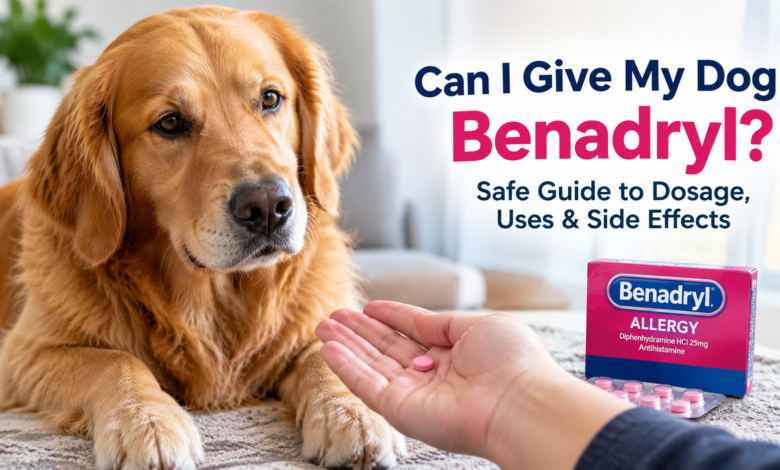
If you are wondering whether you can give my dog Benadryl, The short answer is: sometimes, but only when the product is appropriate and a veterinarian has confirmed that diphenhydramine is suitable for your dog. Benadryl is a brand name commonly associated with diphenhydramine, an antihistamine that veterinarians may use in dogs for certain allergic reactions, hives, and other conditions.
However, human medications are not automatically safe for pets. Your dog’s weight, age, medical history, current medications, and the exact product all matter. This guide explains what Benadryl does, commonly referenced veterinary dosing, potential side effects, dangerous formulations, and when an allergic reaction requires emergency care.
Can I Give My Dog Benadryl Safely?
For some dogs, veterinarians may use diphenhydramine safely. It is a first-generation antihistamine that blocks the effects of histamine, a chemical involved in allergic reactions. Veterinarians may use it for problems such as hives, insect-bite reactions, and certain allergic symptoms.
That does not mean every dog should receive Benadryl. A veterinarian must determine whether the symptoms warrant an antihistamine and whether diphenhydramine is safe for that particular dog.
If you are asking, can i give my dog benadryl because your pet suddenly developed facial swelling, widespread hives, difficulty breathing, repeated vomiting, weakness, or collapse, do not rely on home treatment. Difficulty breathing or collapse can indicate a severe allergic reaction called anaphylaxis and requires immediate veterinary attention.
Remember that an allergy does not always cause itching. Fleas, parasites, infections, skin disease, and other conditions can cause similar symptoms.
What Is Benadryl Used for in Dogs?
Diphenhydramine is primarily an antihistamine. In veterinary medicine, it may be used for certain histamine-related allergic reactions, particularly hives and some insect-bite reactions. It can also have sedative and anti-nausea effects.
Veterinary references list diphenhydramine among medications that may be used for urticaria, or hives, in dogs. However, antihistamines do not work equally well for every type of allergy or every individual dog.
For example, Benadryl should not be viewed as a universal treatment for chronic itchy skin. Dogs with persistent itching may have environmental allergies, fleas, food-related problems, bacterial or yeast infections, or another underlying condition that requires a different treatment.
Some veterinarians may also use diphenhydramine for motion sickness because it can have antiemetic and sedative properties.
Therefore, if you are searching “can I give my dog Benadryl for ongoing itching,” it is better to identify the cause than to repeatedly treat the symptom yourself.
Benadryl Dosage for Dogs: How Much Is Safe?
One commonly referenced veterinary dosage for diphenhydramine in dogs is 2–4 mg per kilogram of body weight, generally administered every 8–12 hours depending on the condition and veterinary direction. Merck Veterinary Manual lists this range for several veterinary uses.
That range should not be treated as permission to calculate and administer a dose without veterinary advice. The appropriate dose and frequency can vary with the dog’s condition, age, health status, and other medications.
For perspective, a veterinarian might calculate a dose based on body weight rather than simply giving a fixed number of tablets. This matters because dogs vary considerably in size.
Another major issue is the formulation. A product that contains diphenhydramine as its only active ingredient differs greatly from a multi-symptom human cold or allergy medicine.
If you are asking whether you can give your dog Benadryl based on a product already in your medicine cabinet, check the complete ingredient list first and contact your veterinarian before giving it.
Never assume that a children’s formulation, liquid product, extended-release capsule, or combination allergy medicine is interchangeable with a standard diphenhydramine product.
Which Benadryl Products Are Dangerous for Dogs?
The biggest mistake owners can make is focusing only on the word “Benadryl” rather than checking the ingredients. Human allergy, cold, cough, and sinus products can contain multiple active ingredients that may be unsafe for dogs.
Some formulations may contain acetaminophen, alcohol, decongestants, or xylitol. Xylitol is particularly dangerous to dogs and can cause serious poisoning. Combination medications can therefore create risks that do not exist with plain diphenhydramine.
Do not substitute time-release products casually. Dogs may absorb medications differently from humans, and an extended-release formulation can create dosing problems.
Before giving any medication, verify:
- The active ingredient is appropriate.
- The medication contains no additional potentially toxic ingredients.
- The strength matches the veterinarian’s instructions.
- The product is not an extended-release formulation unless specifically prescribed.
- The medication has not expired.
If you’re unsure, show the package to your veterinarian or veterinary pharmacist.
Benadryl Side Effects in Dogs
If your veterinarian recommends diphenhydramine, monitor your dog after administration. Sleepiness is a common effect because diphenhydramine can affect the central nervous system. Some dogs can instead become unusually restless or excited.
Other possible effects can include dry mouth, changes in urination, gastrointestinal upset, increased heart rate, or changes in coordination. The severity depends on the amount taken and the individual animal.
If you are wondering can i give my dog benadryl and your dog has already received an inappropriate amount, do not wait for symptoms before contacting a veterinarian.
Possible signs of antihistamine toxicity include agitation or excessive sedation, drooling, rapid breathing, rapid heartbeat, poor coordination, tremors, fever, and seizures.
A suspected overdose should be treated as a veterinary emergency. Do not induce vomiting unless a veterinarian or veterinary poison professional specifically instructs you to do so.
When Should You Avoid Benadryl or Call a Vet?
Diphenhydramine is not appropriate for every dog. Extra caution may be necessary in dogs with glaucoma, heart disease, high blood pressure, urinary or intestinal obstruction, seizure disorders, thyroid problems, or other medical conditions. Pregnancy, nursing, advanced age, and very young age may also change the safety considerations.
Drug interactions are another concern. Tell your veterinarian about prescription medications, supplements, and other over-the-counter products your dog is taking.
Most importantly, do not use Benadryl as a substitute for emergency treatment.
Seek urgent veterinary care if your dog develops:
- Difficulty breathing
- Severe facial or throat swelling
- Collapse or extreme weakness
- Pale or blue gums
- Repeated vomiting after a suspected allergic exposure
- Seizures
- Severe agitation or abnormal behavior
- A known or suspected medication overdose
If the reaction is severe, getting professional treatment quickly is more important than trying to manage it at home.
What Should You Do Before Giving Your Dog Benadryl?
If your dog has mild symptoms and you are considering diphenhydramine, the safest approach is to contact your veterinarian first. Give the dog’s accurate weight, age, symptoms, medical conditions, and medication list.
Tell the veterinarian exactly which product you have, including its active ingredients and strength. This helps prevent accidental exposure to combination products.
If your veterinarian approves diphenhydramine, follow the exact dose and schedule provided. Do not increase the dose simply because the first dose does not appear to work.
Remember that an antihistamine may relieve some symptoms without treating the underlying cause. Persistent itching, recurrent hives, ear problems, skin infections, or repeated allergic episodes deserve veterinary investigation.
So, can i give my dog benadryl? In some circumstances, yes, but the safest answer depends on the individual dog and the exact medication. Veterinary guidance is especially important when symptoms are severe, persistent, or unexplained.
Conclusion
So, can i give my dog benadryl? Diphenhydramine can be used in dogs for certain veterinary conditions, and a commonly referenced dosage range is 2–4 mg/kg, but that does not make every Benadryl product or every situation safe.
The exact product matters because combination human medications may contain ingredients that are dangerous to dogs. You also need to consider your pet’s age, weight, medical history, and other medications.
If you are considering Benadryl for mild allergy symptoms, speak with your veterinarian before administering it. If your dog has trouble breathing, collapses, develops severe swelling, or may have overdosed, seek emergency veterinary care immediately.
More Pet Guides: For more pet-related guides, tips, and helpful information, visit PetOrbit.blog. Thank you for reading this article!
FAQs
Can I give my dog Benadryl for allergies?
If you are asking, “Can I give my dog Benadryl for allergies?” diphenhydramine may be appropriate for certain histamine-related reactions, including hives, when a veterinarian recommends it. It is not equally effective for every type of allergy, so investigate persistent itching rather than treating it repeatedly at home.
How much Benadryl can I give my dog?
A commonly referenced veterinary dose for diphenhydramine is 2–4 mg/kg every 8–12 hours, depending on the condition. However, this is a veterinary dosing reference, not a personalized prescription. Your veterinarian should determine the appropriate dose for your dog.
Can I give my dog Benadryl for itching?
Sometimes, but it depends on why your dog is itchy. Fleas, parasites, infections, environmental allergies, and other skin conditions can all cause itching. Benadryl may not adequately control many causes of chronic itchiness, so veterinary assessment is often more useful than repeated self-treatment.
Does Benadryl make dogs sleepy?
Yes. Diphenhydramine can cause sedation because it affects the central nervous system. However, some dogs may experience the opposite response and become restless or unusually excited. Discuss severe behavioral or neurological changes with a veterinarian.
Can I give my dog Benadryl for a bee sting?
A veterinarian may recommend diphenhydramine for certain mild allergic reactions associated with insect stings. However, facial swelling, breathing difficulty, weakness, collapse, or rapidly worsening symptoms can indicate a serious reaction requiring emergency veterinary treatment.
Can dogs overdose on Benadryl?
Yes. Dogs can develop toxicity after receiving excessive diphenhydramine or an inappropriate human medication. Signs can include agitation, rapid heartbeat, abnormal breathing, tremors, poor coordination, and seizures. Suspected overdose requires immediate veterinary advice.
Can I give my dog liquid Benadryl?
Don’t assume every liquid Benadryl product is safe. Liquid medicines can contain additional ingredients, sweeteners, alcohol, or other substances that may be harmful to dogs. Check the complete ingredient list with your veterinarian before using a liquid formulation.
Can I give my dog Benadryl every day?
Use daily or repeatedly only under veterinary direction. If your dog repeatedly needs an antihistamine, evaluate the underlying cause of the symptoms. A veterinarian may recommend a different treatment that is more appropriate for long-term management.

I’m a Pet Niche Expert and Pet Blogger with 12 years of experience in researching and sharing practical, reliable information about pets. Through PetOrbit.blog, I help pet parents and animal lovers better understand their pets and make informed decisions about their care and well-being.
My expertise covers a wide range of pet topics, including pet health, pet food and nutrition, dog and cat breeds, grooming, behavior, training, safety, pet care, travel with pets, and overall pet wellness. I also explore information about different types of pets, their unique needs, characteristics, lifestyles, and responsible ownership.
With more than 12 years of experience in the pet niche, my focus is on creating clear, useful, and easy-to-understand content based on practical knowledge, careful research, and real-world pet care considerations. I believe pet information should be informative without being unnecessarily complicated, so my goal is to make every article helpful for both new and experienced pet owners.
At PetOrbit, my mission is to provide valuable pet guides, breed information, health and nutrition insights, food and care tips, travel advice, and trustworthy resources that help pets live healthier, happier, and more comfortable lives.
PetOrbit.blog — Practical Pet Knowledge for Better Pet Care.