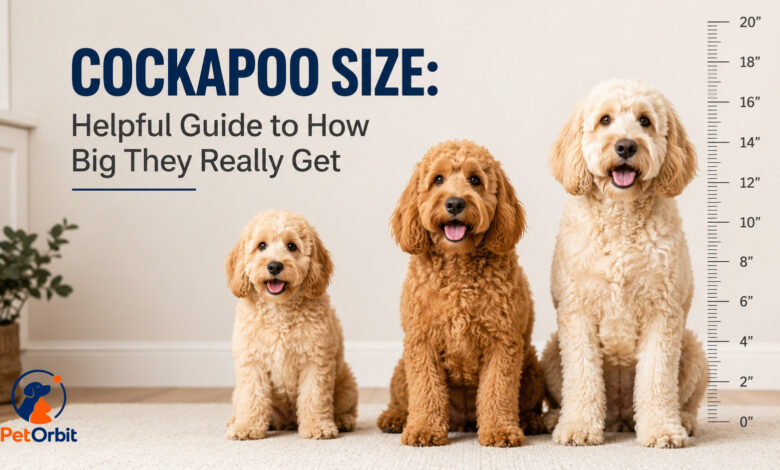
If you are considering a Cockapoo, one of the first questions you may have is, “How big will my dog get?” The answer can vary more than many new owners expect. Cockapoo size depends largely on the type and size of Poodle used in breeding, as well as the Cocker Spaniel parent.
Most Cockapoos are small to medium-sized companion dogs. A typical adult may stand around 10 to 16 inches at the shoulder and weigh roughly 15 to 30 pounds, although some can fall outside those ranges. In this guide, you will learn how large Cockapoos get, when they stop growing, what affects their adult size, and how to estimate a puppy’s future size.
Understanding Cockapoo Size
The Cockapoo is a cross between a Cocker Spaniel and a Poodle. Because Poodles come in different sizes, Cockapoos do not have one universal adult size. Toy and Miniature Poodles are commonly used, producing dogs that can range from quite small to moderately sized.
Purina describes Cockapoos as small-to-medium dogs, with a broad reported range of approximately 25 to 40 cm in height and 3 to 8.5 kg in weight. However, real-world Cockapoos can vary because crossbreeding does not produce identical body types in every generation.
A Cockapoo’s adult size is therefore better viewed as a range rather than a guaranteed measurement. The puppy’s parents, generation, genetics, sex, nutrition, and overall health can all influence the final result.
For prospective owners, this variation is important. A puppy that looks tiny at eight weeks may eventually become a noticeably larger dog, especially if one parent is a larger Poodle.
How Big Do Cockapoos Get?
So, how big do Cockapoos get? Most adults remain comfortably manageable for families, apartments, and smaller homes, but there is considerable individual variation.
A useful general guide is:
- Smaller Cockapoos may weigh around 10 to 15 pounds.
- Medium Cockapoos commonly fall around 15 to 25 pounds.
- Larger individuals may reach 25 to 30 pounds or more.
- Adult height commonly falls around 10 to 16 inches at the shoulder.
These figures should not be treated as a formal breed standard. The Cockapoo is a crossbreed, so there is no single universally accepted size requirement comparable to the official standards used for purebred Poodles or Cocker Spaniels.
The parent breeds help explain the variation. The American Cocker Spaniel is generally around 13.5 to 15.5 inches tall and weighs approximately 20 to 30 pounds, while Poodles can range from Toy to Standard size.
That genetic combination is why two Cockapoo puppies from different litters can mature into noticeably different-sized dogs.
Cockapoo Size by Type
When breeders talk about different Cockapoo sizes, they are usually referring to the Poodle parent involved in the breeding. Names such as Toy, Miniature, and Standard can therefore be useful descriptions, but they are not always used consistently between breeders.
Toy or very small Cockapoos are generally produced using a Toy Poodle parent. They may remain under about 12 inches tall and can weigh around 10 to 15 pounds, although individual dogs can differ.
Miniature Cockapoos are more common. They are generally produced using a Miniature Poodle and often mature into the 12-to-16-inch range, with many weighing approximately 15 to 25 pounds.
Larger Cockapoos can occur when a larger Poodle is involved in the breeding program. These dogs may exceed the size commonly associated with the smaller Cockapoo and can require more space, exercise, and food.
For comparison, the American Kennel Club recognizes Toy Poodles at 10 inches or under, Miniature Poodles at over 10 and up to 15 inches, and Standard Poodles over 15 inches.
Because of this, asking a breeder about the actual adult size of previous litters can be more useful than relying only on labels.
When Do Cockapoos Stop Growing?
Understanding growth stages can make cockapoo size easier to predict.
Most Cockapoos complete much of their height growth during the first year. Smaller individuals often reach close to their adult height earlier, while larger dogs may continue developing for several additional months.
However, reaching adult height does not necessarily mean the dog has finished maturing. A young Cockapoo may continue gaining muscle, filling out through the chest, and developing its adult body shape after its legs have stopped getting noticeably longer.
A rough growth pattern looks like this:
- 8–12 weeks: Rapid puppy growth and development.
- 3–6 months: Significant increases in height, weight, and coordination.
- 6–9 months: Growth continues but usually begins slowing.
- 9–12 months: Many Cockapoos approach their adult height.
- 12–18 months: Larger individuals may continue filling out and maturing.
Genetics remain the strongest predictor. A puppy’s current weight alone cannot guarantee its final adult size.
What Determines a Cockapoo’s Adult Size?
Several factors influence cockapoo size, but genetics are usually the biggest one.
The first consideration is the parents. If both parents are relatively small, the puppies are more likely to remain small. If one parent is substantially larger, the expected range becomes wider.
The generation also matters. A first-generation Cockapoo has a Cocker Spaniel parent and a Poodle parent. Later generations may have different combinations of Cockapoo, Poodle, or Cocker Spaniel ancestry. This can increase variation in body structure and coat characteristics.
Nutrition is another important factor. Puppies need an appropriately balanced diet that supports steady growth. Overfeeding will not safely make a dog larger; instead, excessive weight can place unnecessary stress on developing joints and bones.
Health can also affect growth. Persistent digestive problems, parasites, chronic illness, or nutritional deficiencies can interfere with normal development. If a puppy’s growth seems unusually slow or rapid, a veterinarian can assess body condition, diet, and overall health.
Sex can contribute to differences as well, although individual genetics are generally more important than simply being male or female.
How to Estimate Your Cockapoo’s Adult Weight
There is no perfect formula for predicting a Cockapoo’s final weight, particularly when the parents differ significantly in size. Still, puppy growth records can provide useful clues.
The most reliable approach is to monitor the puppy’s weight regularly and compare its growth pattern with the expected size of its parents. Your veterinarian can also assess whether the puppy is growing appropriately rather than simply focusing on the number on the scale.
Do not try to make a puppy gain weight quickly because you want a bigger adult dog. Healthy growth is more important than reaching a particular size.
Body condition matters, too. A healthy Cockapoo should have a visible waist from above, with ribs that can be felt without being prominently visible. Your veterinarian can help determine whether your puppy is underweight, at an ideal condition, or carrying excess weight.
If you are buying a puppy, ask the breeder for the parents’ current weights and heights, along with information about previous litters. This gives you a much better starting point for estimating cockapoo size than looking at the puppy alone.
Does Cockapoo Size Affect Exercise and Daily Care?
Yes. Size can influence practical care, although Cockapoos of every size generally need regular physical activity and mental stimulation.
A smaller Cockapoo may be easier to carry and may require less food, but that does not mean it is a low-energy dog. The breed combines traits associated with active Cocker Spaniels and intelligent Poodles. Daily walks, play sessions, training, and enrichment can help prevent boredom.
Larger Cockapoos may have greater physical strength and need more room for energetic play. Smaller dogs can still enjoy long walks, but exercise should be appropriate for their age, fitness, and individual health.
Size also affects equipment. Puppies grow quickly, so collars, harnesses, crates, beds, and clothing may need to be replaced as they mature.
Regardless of cockapoo size, owners should focus on maintaining a healthy body condition rather than trying to keep the dog at the smallest possible weight. A properly fed, active Cockapoo can be a wonderful companion in many different living environments.
Choosing the Right Cockapoo for Your Home
Before choosing a Cockapoo puppy, think beyond its appearance. The smallest puppy in a litter is not automatically the best choice for a small home, and a larger puppy is not necessarily harder to manage.
Ask the breeder about expected adult size, parent sizes, previous litters, health screening, and the puppy’s growth history. Responsible breeders should be willing to discuss these details rather than promising an exact adult weight.
Also consider your lifestyle. If you live in an apartment, a smaller Cockapoo may be convenient, but exercise and training requirements still matter. If you have young children, consider the dog’s temperament and supervision needs in addition to its physical size.
Remember that cockapoo size is only one part of choosing a dog. Temperament, health, grooming requirements, exercise needs, and responsible breeding practices are equally important.
Conclusion
The best way to understand cockapoo size is to expect variation rather than a single fixed measurement. Most Cockapoos are small to medium-sized dogs, but their adult height and weight can differ considerably depending on their Poodle parent, Cocker Spaniel parent, generation, and individual genetics.
Many adults fall somewhere around 10 to 16 inches tall and 15 to 30 pounds, while smaller or larger dogs can occur. Puppies often reach most of their height during the first year but may continue filling out afterward.
If you are choosing a Cockapoo puppy, look at the parents, previous litters, growth records, and veterinary assessments. Most importantly, prioritize healthy development over achieving a particular number on the scale. The right Cockapoo is not necessarily the biggest or smallest one—it is the dog whose health, temperament, and needs fit your household.
More Pet Guides: For more pet-related guides, tips, and helpful information, visit PetOrbit.blog. Thank you for reading this article!
(FAQs)
What is the average cockapoo size?
Most adult Cockapoos are small to medium-sized dogs. Many stand around 10 to 16 inches at the shoulder and weigh approximately 15 to 30 pounds, although smaller and larger individuals can occur because the breed has considerable genetic variation.
How big will my Cockapoo puppy get?
Your puppy’s adult size depends primarily on its parents and the Poodle variety used in breeding. Looking at the parents’ height and weight, along with the growth patterns of previous litters, can provide a better estimate than the puppy’s current size alone.
At what age is a Cockapoo fully grown?
Many Cockapoos reach most of their adult height by about 9 to 12 months. However, larger individuals may continue gaining muscle and body mass until around 12 to 18 months. Individual growth rates vary.
Are Cockapoos considered small or medium dogs?
Cockapoos are generally described as small to medium-sized dogs. Their classification can depend on the individual dog’s height and weight because there is no single official size standard covering every Cockapoo.
Does the Poodle parent’s size affect cockapoo size?
Yes. The Poodle parent’s size can have a major influence on the adult dog’s dimensions. Toy and Miniature Poodles are commonly used in Cockapoo breeding, but larger Poodle ancestry can result in bigger offspring.
Can you predict a Cockapoo’s adult weight from puppy weight?
You can make an estimate, but it will not be exact. Tracking weight over time and considering the puppy’s parents gives a more useful prediction. Your veterinarian can also evaluate whether the puppy’s growth is healthy.
Do bigger Cockapoos need more exercise?
Potentially, but size is not the only factor determining exercise needs. Age, health, energy level, temperament, and conditioning all matter. Every Cockapoo should receive appropriate daily physical activity and mental stimulation.
Is cockapoo size important when choosing a puppy?
Yes, but it should not be the only consideration. Expected adult size affects housing, travel, food requirements, equipment, and exercise. However, health, temperament, grooming needs, and responsible breeding should also influence your decision.

I’m a Pet Niche Expert and Pet Blogger with 12 years of experience in researching and sharing practical, reliable information about pets. Through PetOrbit.blog, I help pet parents and animal lovers better understand their pets and make informed decisions about their care and well-being.
My expertise covers a wide range of pet topics, including pet health, pet food and nutrition, dog and cat breeds, grooming, behavior, training, safety, pet care, travel with pets, and overall pet wellness. I also explore information about different types of pets, their unique needs, characteristics, lifestyles, and responsible ownership.
With more than 12 years of experience in the pet niche, my focus is on creating clear, useful, and easy-to-understand content based on practical knowledge, careful research, and real-world pet care considerations. I believe pet information should be informative without being unnecessarily complicated, so my goal is to make every article helpful for both new and experienced pet owners.
At PetOrbit, my mission is to provide valuable pet guides, breed information, health and nutrition insights, food and care tips, travel advice, and trustworthy resources that help pets live healthier, happier, and more comfortable lives.
PetOrbit.blog — Practical Pet Knowledge for Better Pet Care.