Fully Grown Cavapoochon: Wonderful Size, Weight, Care & Adult Guide
Fully Grown Cavapoochon

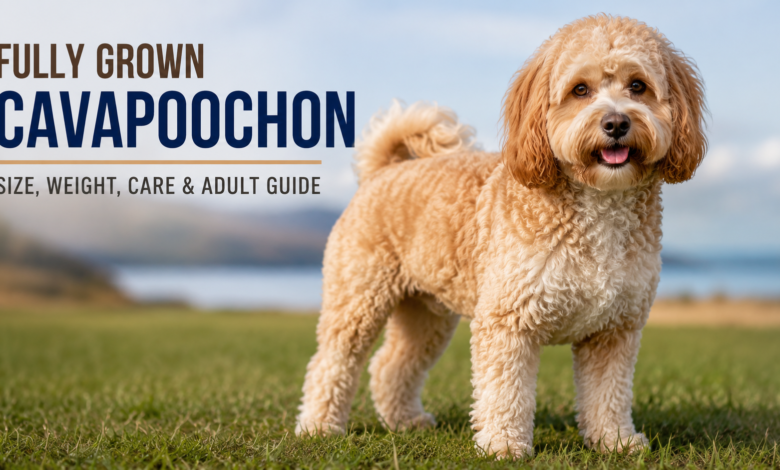
A fully grown cavapoochon keeps the adorable teddy-bear appearance that makes this designer cross so popular, but its adult body can look noticeably different from its puppy stage. If you are wondering how big your Cavapoochon will become, when growth stops, or what adult care involves, the answer depends heavily on genetics and the size of the Poodle used in the breeding.
A Cavapoochon combines the Cavalier King Charles Spaniel, Bichon Frise, and Poodle. Because it is a mixed breed rather than a standardized purebred, there is no single official adult size. Most are small companion dogs, but individual height, weight, coat texture, and body shape can vary.
How Big Is a Fully Grown Cavapoochon?
Most adult Cavapoochons remain relatively small. Common estimates place adult dogs around 8–18 pounds and approximately 9–14 inches tall at the shoulder, although some individuals can fall outside these ranges depending on their parents and generation.
Some breeder and breed-guide sources report somewhat broader ranges, including approximately 5–10 kg and 25–35 cm. This variation is important because terms such as “Toy,” “Mini,” and “Standard” are not applied consistently across Cavapoochon breeders.
The Poodle parent can have a particularly strong influence on final size. A Toy Poodle generally produces a smaller dog than a Miniature Poodle. The sizes of the Cavalier and Bichon parents also matter, as do the proportions of each breed in a multigenerational dog.
For that reason, a puppy’s current weight alone cannot guarantee its eventual adult size. Looking at both parents and, when available, previous litters from the same breeding line can provide a better indication.
When Does a Fully Grown Cavapoochon Stop Growing?
Many Cavapoochons reach most of their adult height by around 10–12 months, although some continue filling out until approximately 12–18 months. Smaller dogs generally mature sooner, while dogs with larger Poodle genetics may take longer.
Growth is not perfectly linear. A puppy may gain weight quickly during its early months and then appear to slow down considerably. Even after reaching its adult height, it can develop more muscle and body condition.
A useful way to judge maturity is to look for several signs together:
- Height remains stable for several months.
- Weight stays relatively consistent with an appropriate diet.
- The puppy begins developing an adult body shape.
- Your veterinarian confirms that physical development is progressing normally.
Do not try to make a puppy grow faster by increasing food. Excess calories can promote unhealthy weight gain rather than healthy development. A veterinarian can assess body condition and recommend an appropriate feeding plan.
What Does a Fully Grown Cavapoochon Look Like?
The adult Cavapoochon commonly has a compact body, expressive eyes, floppy ears, and a soft wavy or curly coat. Its appearance can vary considerably because all three parent breeds contribute different physical characteristics.
The Cavalier King Charles Spaniel contributes the gentle expression, long ears, and affectionate companion-dog appearance. Bichon Frise genetics can contribute a fluffy coat and rounded facial appearance, while the Poodle can contribute curlier hair, intelligence, and a lower-shedding coat.
Coat color can include cream, apricot, red, gold, black, chocolate, sable, or combinations with white markings. The exact appearance depends on the dog’s genetics.
It is also worth correcting a common misconception: low-shedding does not mean completely allergy-free. No dog is truly 100% hypoallergenic because allergens come from sources including skin, saliva, and other biological materials. Poodle and Bichon genetics may result in less shedding, but allergy-sensitive households should spend time with the individual dog before making a decision.
Adult Temperament, Exercise and Training Needs
A fully grown cavapoochon is generally suited to people looking for an affectionate, social companion rather than a high-endurance working dog. The Cavalier contributes a people-oriented nature, the Bichon adds sociability and playfulness, and the Poodle contributes intelligence and trainability.
Most adults benefit from daily walks combined with indoor play and mental stimulation. Exercise requirements vary by individual, but a combination of short walks, interactive games, sniffing opportunities, and training sessions can help keep an adult dog physically and mentally satisfied. Some breed guides suggest roughly 20–45 minutes of daily structured exercise, depending on the dog’s age, health, and energy level.
Training should remain reward-based. Cavapoochons are often responsive to positive reinforcement, and short sessions can work better than repetitive drills.
Because they tend to form strong attachments to their owners, alone-time training is also important. A dog that is never taught to relax independently may become distressed when left alone. Gradually increasing separation time, providing enrichment, and maintaining predictable routines can help.
Grooming, Nutrition and Health of a Fully Grown Cavapoochon
The attractive adult coat requires regular maintenance. Wavy or curly hair can trap loose material and form mats, particularly around the ears, legs, armpits, and collar area. Regular brushing and professional grooming can keep the coat comfortable and manageable.
Do not judge grooming needs simply by how little the dog sheds. A low-shedding curly coat can actually require more maintenance because shed hair may remain trapped in the coat instead of falling away.
Nutrition is equally important. Adult food should be selected according to the dog’s size, activity level, body condition, and individual health needs. Small dogs can gain excess weight surprisingly quickly because even a few extra treats represent a meaningful percentage of their daily calories. Treats should generally remain a small portion of the overall diet.
The parent breeds also mean owners should take health screening seriously. Hybrid status does not guarantee freedom from inherited disease. Cavapoos, for example, can be affected by conditions such as hip dysplasia and patellar luxation, while Cavalier genetics are associated with important inherited health concerns.
For a fully grown cavapoochon, regular veterinary examinations are useful for monitoring weight, teeth, joints, heart health, skin, ears, and overall condition. Dental care deserves particular attention because small dogs can be prone to dental problems.
A healthy adult lifespan is commonly estimated at roughly 12–15 years, although individual longevity depends on genetics, preventive healthcare, nutrition, exercise, and overall living conditions.
Is a Fully Grown Cavapoochon a Good Family Dog?
For many households, yes. Their small size can make them practical for apartments and smaller homes, while their playful and affectionate nature can suit families, couples, and individuals.
However, “small” does not mean fragile or maintenance-free. Young children should always be taught to interact gently with a dog, and supervision is especially important because accidental falls, squeezing, or rough handling can injure a small companion.
Cavapoochons can also live successfully with other dogs and pets when introductions are gradual and positive. Individual temperament matters more than breed labels, so owners should assess the specific dog’s behavior and socialization history.
They are less suitable for households where the dog will routinely be left alone for very long periods. Their people-focused nature can make companionship a significant part of their quality of life.
How to Keep Your Adult Cavapoochon Healthy
Keeping an adult Cavapoochon healthy is less about achieving a particular number on the scale and more about maintaining an appropriate body condition.
Owners should monitor weight regularly, provide daily movement, brush the coat consistently, maintain dental hygiene, and keep vaccinations and parasite prevention up to date according to veterinary advice.
A practical adult-care routine includes:
- Measure food rather than estimating portions.
- Keep treats controlled.
- Provide daily walks and mental enrichment.
- Brush regularly to prevent mats.
- Check ears and paws during grooming.
- Brush teeth routinely using appropriate canine dental products.
- Schedule regular veterinary examinations.
- Watch for persistent changes in appetite, drinking, movement, behavior, or energy.
If an adult dog suddenly gains weight, loses weight, becomes reluctant to exercise, develops persistent coughing, or shows pain or behavioral changes, veterinary assessment is more appropriate than simply changing its diet.
Conclusion
A fully grown cavapoochon is usually a small, affectionate companion with a teddy-bear appearance, but there is no single guaranteed adult size. Most fall somewhere around 8–18 pounds and 9–14 inches, with broader ranges possible because this is a variable three-breed cross.
Most reach close to their adult height by about one year, while some continue filling out into the following months. Genetics, especially the Poodle parent’s size, plays an important role.
The best approach is to focus less on achieving an exact weight and more on healthy body condition, appropriate nutrition, exercise, grooming, training, dental care, and preventive veterinary care. With consistent care, a fully grown cavapoochon can remain an affectionate and engaging companion for many years.
More Pet Guides: For more pet-related guides, tips, and helpful information, visit PetOrbit.blog. Thank you for reading this article!
(FAQs)
How big is a fully grown cavapoochon?
A fully grown cavapoochon commonly weighs around 8–18 pounds and stands about 9–14 inches at the shoulder. However, individual dogs can be smaller or larger depending on parental size, generation, and genetics.
At what age is a Cavapoochon fully grown?
Many Cavapoochons reach most of their adult height around 10–12 months. Some continue gaining body mass and filling out until approximately 12–18 months, particularly when larger Poodle genetics are involved.
How much should a fully grown Cavapoochon weigh?
There is no universal ideal weight because adult size varies. A dog weighing 10 pounds may be perfectly healthy, while another may naturally be healthy at 16 pounds. Body condition, muscle, frame size, age, and activity level are more useful than a number alone.
Is a fully grown Cavapoochon hypoallergenic?
No dog is completely hypoallergenic. Cavapoochons may shed relatively little when they inherit Poodle and Bichon coat characteristics, but they can still produce allergens. People with allergies should interact with the individual dog before deciding to bring one home.
Does a fully grown Cavapoochon need a lot of exercise?
Usually, they need moderate daily activity rather than intense exercise. Walks, interactive play, sniffing activities, and short training sessions can provide a good combination of physical and mental stimulation. Individual exercise needs should be adjusted for age and health.
Do fully grown Cavapoochons need professional grooming?
Many do. Their wavy or curly coats can mat if they are not brushed and maintained regularly. Professional grooming can help keep the coat short and manageable, while routine brushing at home helps prevent painful tangles.
How long does a Cavapoochon live?
Many breed guides estimate a lifespan of roughly 12–15 years. Genetics, preventive veterinary care, nutrition, dental health, exercise, and overall lifestyle can all influence an individual dog’s longevity.
Is a fully grown Cavapoochon good for apartment living?
Often, yes. Their small size and moderate exercise needs can make them suitable for apartments, provided they receive daily walks, play, training, social interaction, and appropriate mental stimulation. Living space alone does not determine whether an individual dog will thrive.

I’m a Pet Niche Expert and Pet Blogger with 12 years of experience in researching and sharing practical, reliable information about pets. Through PetOrbit.blog, I help pet parents and animal lovers better understand their pets and make informed decisions about their care and well-being.
My expertise covers a wide range of pet topics, including pet health, pet food and nutrition, dog and cat breeds, grooming, behavior, training, safety, pet care, travel with pets, and overall pet wellness. I also explore information about different types of pets, their unique needs, characteristics, lifestyles, and responsible ownership.
With more than 12 years of experience in the pet niche, my focus is on creating clear, useful, and easy-to-understand content based on practical knowledge, careful research, and real-world pet care considerations. I believe pet information should be informative without being unnecessarily complicated, so my goal is to make every article helpful for both new and experienced pet owners.
At PetOrbit, my mission is to provide valuable pet guides, breed information, health and nutrition insights, food and care tips, travel advice, and trustworthy resources that help pets live healthier, happier, and more comfortable lives.
PetOrbit.blog — Practical Pet Knowledge for Better Pet Care.