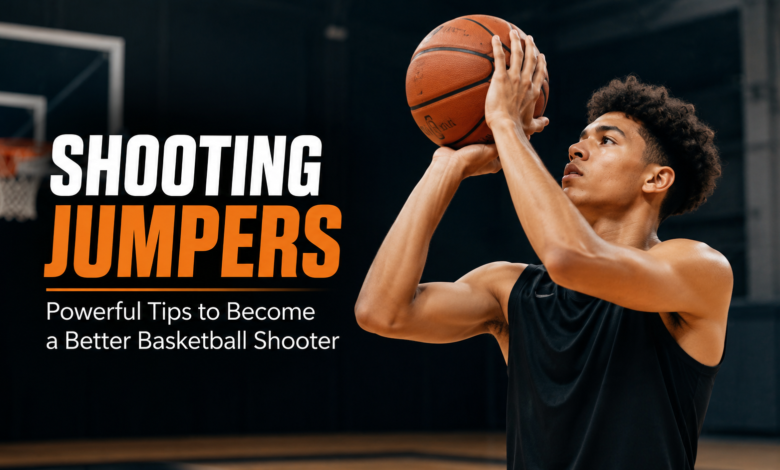
A reliable jump shot can completely change the way a basketball player scores. Whether you are a beginner learning proper mechanics or an experienced player trying to stay consistent, shooting jumpers takes more than simply throwing the ball toward the basket. Balance, footwork, hand placement, body control, timing, and repetition all work together.
The good news is that you can develop your shooting ability. You do not need to rely entirely on natural talent. With proper mechanics and purposeful practice, you can build a repeatable motion that holds up during games. This guide explains how to improve shooting jumpers, avoid common mistakes, develop range, and practice efficiently.
What Makes Shooting Jumpers Effective?
A good jump shot starts before the ball leaves your hands. Shooters need a stable base, controlled movement, consistent alignment, and a smooth release. When these elements work together, the shot becomes easier to repeat under pressure.
The priority is balance. Your feet should provide a strong foundation without making you feel stiff. Most players use a slightly staggered stance, with the shooting-side foot positioned naturally in relation to the basket. Keep your knees and hips comfortably bent so you can generate power from your lower body.
As you rise, move fluidly, not rushed. The legs, torso, shooting arm, wrist, and fingers should work as one sequence. A strong jump shot is not about using maximum force. It is about transferring energy efficiently from the floor to the basketball.
For consistent shooting jumpers, think about creating the same basic motion every time. Your exact form may differ slightly from another player’s technique, but your own mechanics should remain repeatable.
How to Build Proper Shooting Jumpers Mechanics
Hand placement is one of the most important parts of shooting. Your shooting hand should control the basketball while the guide hand provides stability without pushing the ball sideways. Keep the fingers comfortably spread and avoid gripping the ball too tightly.
Your elbow should generally stay underneath or reasonably aligned with the ball as you prepare to shoot. This creates a more direct path to the basket. However, forcing your elbow into a perfectly straight position can feel uncomfortable. Natural, repeatable mechanics matter more than copying another player’s exact posture.
The release should finish with the shooting arm extending toward the target and the wrist relaxed. A natural wrist snap helps create backspin. Your fingers should point toward the basket after release rather than immediately turning away.
Follow-through helps reinforce the correct finishing position. Hold it briefly instead of dropping your arm immediately after releasing the ball.
For shooting jumpers, remember this simple sequence:
- Establish balance and prepare your feet.
- Bring the ball into a comfortable shooting pocket.
- Bend naturally through the knees and hips.
- Rise smoothly while extending the shooting arm.
- Release the ball at a consistent point.
- Finish with a relaxed wrist and controlled follow-through.
Why Footwork Matters When Shooting Jumpers
Many shooting problems are actually footwork problems. If your feet are moving unpredictably, your upper-body mechanics have to compensate. That makes your release inconsistent.
Practice catching the ball and getting into your shooting stance without unnecessary movement. If you are shooting off the dribble, learn to stop under control before rising. A controlled one-two step or jump stop can help you establish balance depending on the situation and your preferred technique.
Players should also practice different game situations. A stationary catch-and-shoot jumper is different from a shot after a hard dribble, a step-back, or movement around a screen. Each situation requires control of your center of gravity.
When shooting jumpers off the dribble, avoid leaning excessively backward or sideways unless the shot specifically requires it. Creating unnecessary body movement makes accuracy harder.
Good footwork also improves speed. The goal isn’t just to shoot correctly when standing still. You want to reach a balanced shooting position quickly enough to use the technique during real possessions.
How to Improve Accuracy and Shooting Range
Distance should be developed gradually. If you cannot maintain your normal mechanics from a particular distance, moving farther away may reinforce bad habits rather than improve your range.
Start close to the basket and focus on clean releases. Once your form becomes consistent, gradually move backward. The goal is to extend your range while keeping the same fundamental motion.
Accuracy also improves when you stop judging every shot only by whether it goes in. Pay attention to the quality of the attempt. Did your feet stay balanced? Was the release smooth? Did the ball leave your hand cleanly? Did you finish toward the target?
These details provide useful feedback.
For better shooting jumpers, practice shots from several areas of the court rather than repeatedly shooting from one favorite spot. Include mid-range attempts, perimeter shots, shots after movement, and game-speed repetitions.
A useful progression is:
- Form shooting close to the basket.
- Stationary jumpers from several spots.
- Catch-and-shoot repetitions.
- Shots after one or two dribbles.
- Movement-based shooting.
- Competitive or game-speed shooting.
Range should follow consistency, not replace it.
Common Mistakes When Shooting Jumpers
One common mistake is using too much upper-body strength. Players who struggle to reach the basket from distance often throw the ball harder instead of improving their lower-body contribution and shooting rhythm.
Another problem is changing the release point from shot to shot. A constantly changing release makes it difficult to develop reliable muscle memory.
Rushing is also common. Some players catch the ball and immediately launch without getting balanced. A quick shot can still be technically sound, but speed should come from efficient preparation, not panic.
Leaning backward unnecessarily can also reduce accuracy. Unless you are creating separation from a defender, keeping your body controlled helps you transfer force more efficiently.
Finally, avoid practicing only successful shots. If a particular mistake appears repeatedly, slow down and correct it. Quality repetition is more valuable than mindlessly taking hundreds of attempts.
Best Practice Drills for Shooting Jumpers
Effective shooting practice should have a purpose. Instead of simply counting shots, create drills that challenge different parts of your game.
Form shooting is an excellent starting point. Stand close to the basket and concentrate on hand placement, alignment, release, and follow-through. Because you are close to the rim, you can focus on technique without needing excessive power.
Next, use spot shooting. Choose several locations around the court and make a set number of shots from each. This develops consistency from different angles.
Movement shooting is especially valuable for players who want their jump shot to transfer into games. Start without a defender by moving into space, receiving a pass, establishing your feet, and shooting immediately.
You can also add dribble pull-ups. Take one or two controlled dribbles, stop under control, and rise into your jumper. Begin slowly before increasing game speed.
Finally, include pressure. Give yourself a target such as making a certain number consecutively or reaching a score before ending the drill. Controlled pressure helps develop concentration and decision-making.
How to Make Shooting Jumpers More Consistent in Games
Practice form alone is not enough. Basketball games involve defenders, fatigue, movement, changing distances, and limited time. Your training should eventually reproduce those conditions.
Start by learning where your best shots come from. Track your shooting during practice and games if possible. You may discover that your percentage is much stronger from certain areas or after particular actions.
Conditioning also matters. A player’s shooting mechanics can deteriorate when the legs become tired. Adding shooting drills after controlled movement or basketball conditioning can help you learn to maintain technique under fatigue.
Shot selection is equally important. Becoming a better shooter does not mean taking every difficult jumper. Good players understand when they are open, when a defender is closing out, and when another option is better.
Confidence should come from preparation, not emotion. If you have repeatedly practiced your footwork, release, and game-speed shots, you have something concrete to rely on when the game becomes difficult.
Conclusion
Improving shooting jumpers is a process built around mechanics, balance, footwork, repetition, and intelligent practice. Start close to the basket, establish a comfortable and repeatable motion, and gradually increase distance and difficulty.
Do not chase range at the expense of accuracy. Instead, build strong fundamentals, then challenge them through movement, pressure, and game-speed situations. With consistent practice, shooting jumpers can become a dependable part of your offensive game.
The best shooter is not necessarily the player who takes the most shots. It is the player who practices with purpose and can reproduce sound mechanics when the game demands it.
More Pet Guides: For more pet-related guides, tips, and helpful information, visit PetOrbit.blog. Thank you for reading this article!
(FAQs)
What is the most important part of shooting jumpers?
Balance and consistency are among the most important factors. A stable base allows the rest of the shooting motion to work efficiently. From there, focus on controlled hand placement, a repeatable release, and a relaxed follow-through.
How often should I practice shooting jumpers?
Regular practice is more useful than occasional marathon sessions. Even shorter workouts can produce results when they include purposeful repetitions. Focus on quality and gradually increase volume as your technique improves.
Why do my jump shots keep falling short?
Short shots can result from several factors, including insufficient lower-body contribution, poor balance, an inconsistent release, or excessive tension. Rather than simply shooting harder, examine your mechanics and practice closer to the basket until your motion becomes smoother.
Should I practice shooting jumpers from close range first?
Yes. Close-range shooting allows you to concentrate on release mechanics without requiring much force. Once you can consistently control the ball and finish with good technique, gradually increase the distance.
How can I improve my three-point shooting?
Build three-point range gradually. Start at a distance where you can maintain your normal mechanics, then move farther back as your accuracy and control improve. Include catch-and-shoot, movement, and game-speed repetitions rather than relying exclusively on stationary attempts.
Does footwork really affect shooting jumpers?
Absolutely. Poor footwork can leave your body off balance before the release even begins. Practicing controlled stops, proper spacing, and efficient preparation helps you reach a stronger shooting position and improves consistency.
How do I stop rushing my jump shot?
Practice creating a consistent preparation routine. Get your feet organized, bring the ball into position, and rise smoothly. As the movement becomes automatic, increase your speed without sacrificing balance or control.
Can practicing more shots automatically make me a better shooter?
Not necessarily. Repetition helps only when it reinforces useful mechanics. Thousands of poorly executed attempts can strengthen bad habits. Purposeful practice, feedback, different game situations, and gradual progression are more valuable than simply maximizing shot volume.

I’m a Pet Niche Expert and Pet Blogger with 12 years of experience in researching and sharing practical, reliable information about pets. Through PetOrbit.blog, I help pet parents and animal lovers better understand their pets and make informed decisions about their care and well-being.
My expertise covers a wide range of pet topics, including pet health, pet food and nutrition, dog and cat breeds, grooming, behavior, training, safety, pet care, travel with pets, and overall pet wellness. I also explore information about different types of pets, their unique needs, characteristics, lifestyles, and responsible ownership.
With more than 12 years of experience in the pet niche, my focus is on creating clear, useful, and easy-to-understand content based on practical knowledge, careful research, and real-world pet care considerations. I believe pet information should be informative without being unnecessarily complicated, so my goal is to make every article helpful for both new and experienced pet owners.
At PetOrbit, my mission is to provide valuable pet guides, breed information, health and nutrition insights, food and care tips, travel advice, and trustworthy resources that help pets live healthier, happier, and more comfortable lives.
PetOrbit.blog — Practical Pet Knowledge for Better Pet Care.